
Cart
There are no more items in your cart



How to Fix Cannabis Deficiencies

The topic we are going to cover in this guide on how to fix cannabis nutrient deficiencies could easily be enough to fill a whole book, and many of the eager readers going through this right now would surely dive straight into soaking up all the knowledge it contains. Most cannabis growers are self-taught and extremely open to learning.
If you started reading this guide, you probably have an unresolved problem with one of your plants, so at Sweet Seeds® we are going to explain what cannabis nutrient deficiency is, how it can affect growth, development, and bud production, and how you can detect it in order to find a solution.
Identifying and correcting these cannabis deficiencies in time will prevent serious consequences in the grow that could lead to a partial loss of your precious harvest, or even a total loss in the worst-case scenario.
So, come on, let’s play plant doctors.
What Are Nutrient Deficiencies in Cannabis Plants?
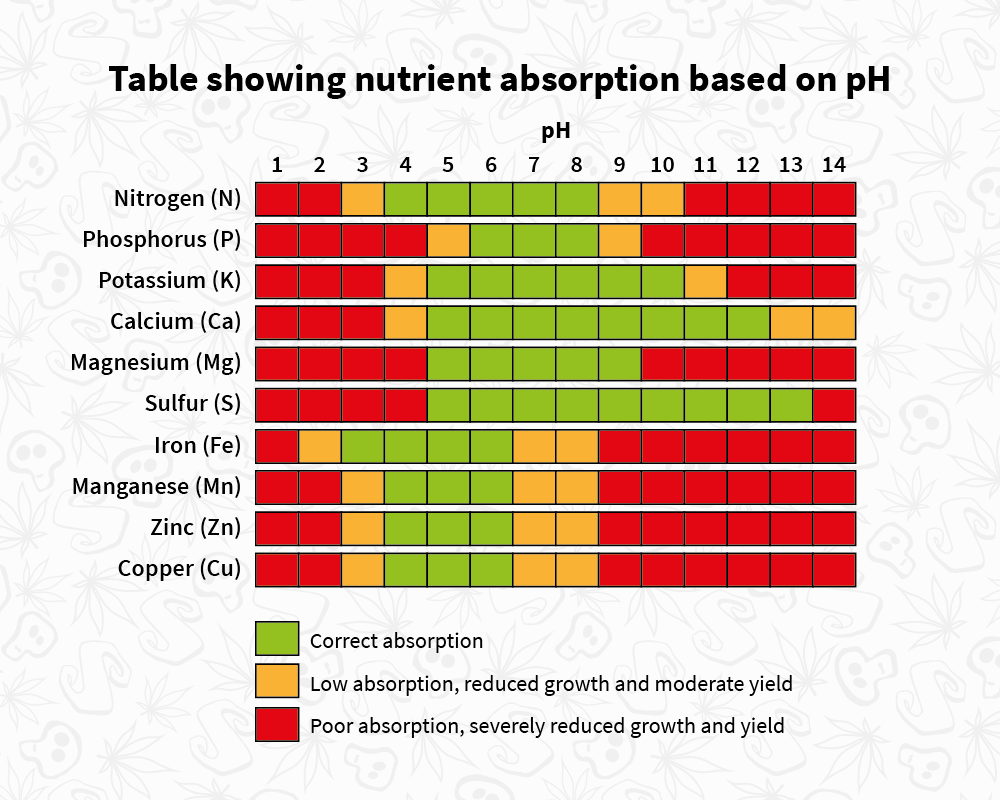
Most diseases and deficiencies in cannabis plants weaken their immune system and cause nutrient deficiencies, depriving them of nutrients that are essential for proper development. Imagine having a pet and depriving it of food for a while or feeding it poor-quality food with a weak composition lacking essential vitamins. After some time, the pet would become sick, weakened, and could even die.
Fortunately, cannabis plants speak to us through their leaves and overall appearance. Learning to distinguish and identify cannabis nutrient deficiencies pushes home growers to investigate until they find the solution to the problem. It is very satisfying when you figure it out and manage to save a plant you have been taking care of for so long.
Before anything else, let us lay out the nutrients cannabis needs. There are three elements that the plant absorbs from the environment, air and water: carbon, hydrogen, and oxygen. The rest are absorbed through the roots or at the foliar level, meaning through the leaves.
In addition, these nutrients can be mobile or immobile. Mobile nutrients are able to move through the plant, from the reserves stored in the larger, older leaves, when needed. On the other hand, immobile nutrients cannot move from one part of the plant to another.
This helps a lot when interpreting which element may be causing the problem: mobile nutrients will show deficiencies in the older leaves, while immobile ones will show them in the newer leaves.
In this guide on cannabis nutrient deficiencies, we are going to focus on soil nutrients, which are divided into:
Macronutrients
There are three main macronutrients, NPK, which appear after the decomposition of organic matter or are provided through fertilizers, and which the plant consumes in greater quantities:
- Nitrogen (N): A mobile nutrient that the plant needs in large amounts. It is responsible for the green color because it helps form chlorophyll, which is used in photosynthesis. It is essential for creating amino acids, protein formation, and adenosine triphosphate, ATP. Nitrogen is necessary for life because it is part of DNA and RNA.
- Phosphorus (P): A mobile nutrient found in all the plant’s cells. It takes part in a long list of vital physiological processes such as photosynthesis and the transfer of energy and nutrients, among others. During the vegetative stage, it provides strength to the stems and helps create roots. It is a great aid in fighting disease and is also essential for flower production.
- Potassium (K): A mobile nutrient of great importance in the opening of the stomata, so it is directly related to hydration and water retention in the plant. Without it, important metabolic functions, plant growth, and root formation would all be affected. It helps the plant tolerate stress and is key to protein synthesis.
There are also three secondary macronutrients, which the plant needs in smaller amounts:
- Calcium (Ca): An immobile nutrient that regulates hormonal and enzymatic activity. Thanks to calcium, plants build their structure by keeping cell walls and membranes together. It helps the plant resist disease and environmental stress. It also helps the plant absorb other nutrients.
- Magnesium (Mg): A mobile nutrient that is essential for photosynthesis and chlorophyll synthesis. It is crucial in energy transfer within the plant and participates in cell division, protein synthesis, and enzyme activation, among other functions.
- Sulfur (S): A semi-mobile nutrient that helps in the formation of proteins, vitamins such as vitamin B1, and amino acids. It is not needed in large amounts, but it is important that it is not lacking, since it helps metabolize other nutrients such as nitrogen. It also supports photosynthesis.
Micronutrients
Although the plant demands them in smaller amounts, they are necessary for proper development. Here is the list:
- Iron (Fe): Immobile, crucial for chlorophyll formation and photosynthesis. It helps in the production of proteins and enzymes.
- Manganese (Mn): Immobile, very important in photosynthesis and nitrate metabolism. It acts as a cofactor in several enzymatic reactions.
- Copper (Cu): Immobile, involved in photosynthesis and in the metabolism of carbohydrates and proteins. It is essential for the lignification of cell walls.
- Boron (B): Immobile, essential for cell wall formation and cell membrane integrity. It helps in pollination and fruit development.
- Molybdenum (Mo): Immobile, fundamental to nitrogen metabolism. It acts as a cofactor in the enzymes that reduce nitrates to ammonium.
- Zinc (Zn): Immobile, necessary for protein synthesis and hormone production. It helps with plant growth and disease resistance.
- Chloride (Cl): Mobile, important for osmoregulation and water balance in the plant. It participates in photosynthesis and in the opening and closing of the stomata.
Main Causes of Cannabis Deficiencies
Let’s now take a look at the main causes of cannabis nutrient deficiencies.
A Soil or Substrate That Is Poor in Nutrients
One of the main causes of cannabis deficiencies comes from planting in substrates that are not balanced or do not contain a sufficient amount of nutrients. If you do not have much experience, it is essential to buy a special substrate for cannabis.
If you already have experience, you can prepare the substrate yourself, but for a price that is not excessive, you can get good substrates at your trusted grow shop, making sure that, at least during its first stage, your cannabis plants will have everything they need for proper development.
Imbalance in Soil or Water pH
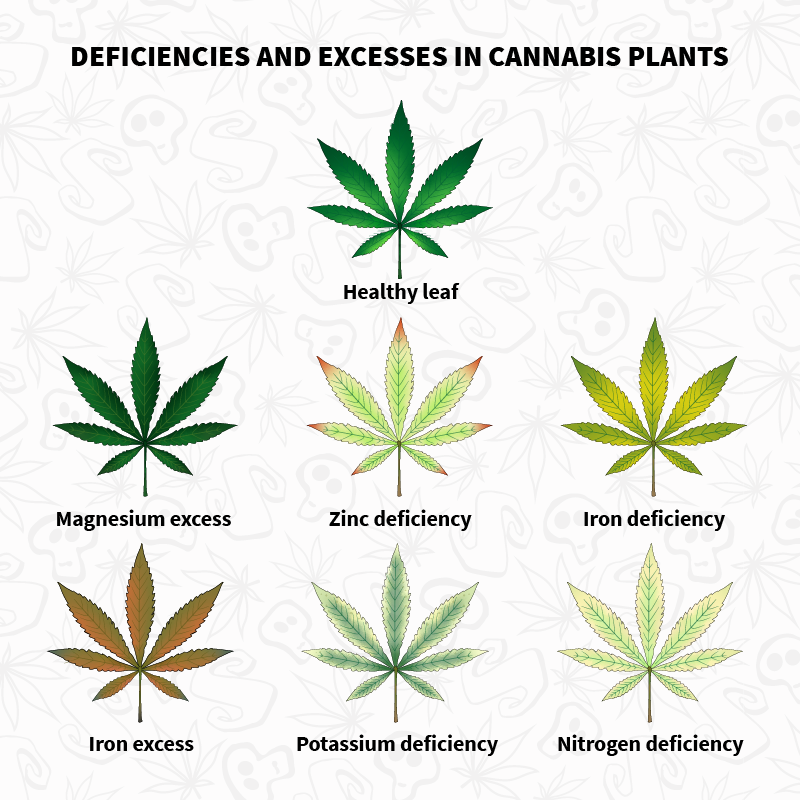
pH is a measurement used to determine acidity or alkalinity, and it is essential for the plant to be able to absorb nutrients. Any imbalance in it will cause deficiencies and nutrient lockout, so we recommend checking it often with a digital meter or with drops.
The optimal uptake range is between 6.0 and 6.5 because that is where most nutrients are absorbed. If there is any imbalance, the plant will start to show deficiencies.
Excess or Lack of Fertilizers
While a lack of nutrients is harmful to plant development and health, an excess causes toxicity and creates an imbalance, preventing some nutrients from being absorbed. Try to follow the fertilizer manufacturers’ instructions and do not overuse them. Keep in mind that good soil already contains nutrients, so you may not need to use too much fertilizer during the first few weeks.
There are other variables that can cause cannabis deficiencies, such as poor growing practices, diseases or pests, overwatering or underwatering, or extreme weather conditions.
It is up to you to identify the problem so you can act and correct it.
Common Symptoms of Cannabis Nutrient Deficiencies
Let’s look at the most common visual symptoms that indicate a cannabis plant is dealing with nutrient deficiencies.
Nitrogen Deficiency (N)
It shows itself very clearly through discoloration, from light green to yellow, beginning in the plant’s oldest and largest leaves in the lower part of the plant. Little by little, the rest of the leaves will also become discolored if the problem is not corrected, and the plant will suffer from slow, stunted growth.
Phosphorus Deficiency (P)
Phosphorus deficiency in plants shows several notable visual symptoms, such as leaves and stems that may turn dark green, purple, or reddish, especially in the older leaves.
Necrotic spots may also appear on the leaves, and there will be a significant decrease in both the quantity and quality of the buds. The roots may become thin and less branched, while the stems may become thin and brittle.
Potassium Deficiency (K)
Yellow edges appear on the leaves, on the tips and margins, which eventually dry out. Growth slows down and bud production is reduced. The roots become weak and are prone to be attacked by harmful fungi.
Calcium and Magnesium Deficiency
When calcium is lacking, the new leaves become deformed and smaller. In addition, discoloration appears and eventually turns into brown spots between the veins and along the edges of the leaves. The plant loses its shine and overall growth becomes stunted.
In magnesium deficiency, discoloration appears between the veins and, as it progresses, turns into yellow spots that eventually become brown. It begins first in the older leaves and is usually accompanied by premature leaf loss. The plant loses vigor and shows reduced growth.
How to Fix Cannabis Nutrient Deficiencies
To fix nutrient deficiencies in cannabis plants, the first step is to identify them correctly. Once we determine which deficiency, or deficiencies, are affecting the plant, the issue can be corrected either through an extra nutrient supply or with a simple pH adjustment.
There is also a universal solution for deficiencies when you are not completely sure of the cause. This consists of thoroughly flushing the substrate and leaching out excess nutrients. Doing it for around 10 minutes is usually more than enough, or you can alternatively use a volume of water of approximately three times the size of the pot you are using, followed by watering with a fertilizer suitable for cannabis in order to replace, in a balanced way, all the nutrients removed during the flush. It is like resetting the substrate, and it is often the ideal solution.
Adjusting pH to Improve Nutrient Uptake
Very often, nutrient deficiency in cannabis is caused by nutrient lockout due to an incorrect pH. It is very important to measure the pH of the irrigation water once you have added the fertilizers and correct it if necessary. If the crop is grown in soil, the ideal pH is around 6.0 to 6.5. If it is grown in coco or hydroponics, the ideal range would be between 5.5 and 6.0.
This practice solves most nutrient imbalance issues, so it is something you should never overlook.
Using Specific Fertilizers and Supplements
Always use fertilizers specifically designed for cannabis and do not cut corners with them. Plants need complete nutrition in order to give us the best buds possible. Try to use specific supplements such as Cal/Mag so that your plants always have a good supply available.
Soil Amendments and Improvers
The use of compost or worm humus is a great ally in preventing long-term deficiencies. Likewise, we can add wood ash, dolomite as a source of calcium and magnesium, gypsum, or bone meal.
Besides providing nutrients, these also improve soil structure.
One product that can help is hydro-absorbent polymers or hydrogels such as Terracotem, since in addition to improving soil moisture, they provide balanced macro and micronutrient nutrition to your cannabis plants.
How to Prevent Cannabis Deficiencies in Future Grows
Planning a Balanced Fertilization Program
Ideally, you should use a good fertilizer line, whether organic or mineral, and follow the feeding charts provided by the manufacturers themselves. It is important not to mix too many products from different brands, because incompatibilities may arise between them.
Likewise, you need to train your instincts to detect any sign that indicates a feeding imbalance and act before the problem gets worse.
Regular Monitoring of pH and Nutrient Levels
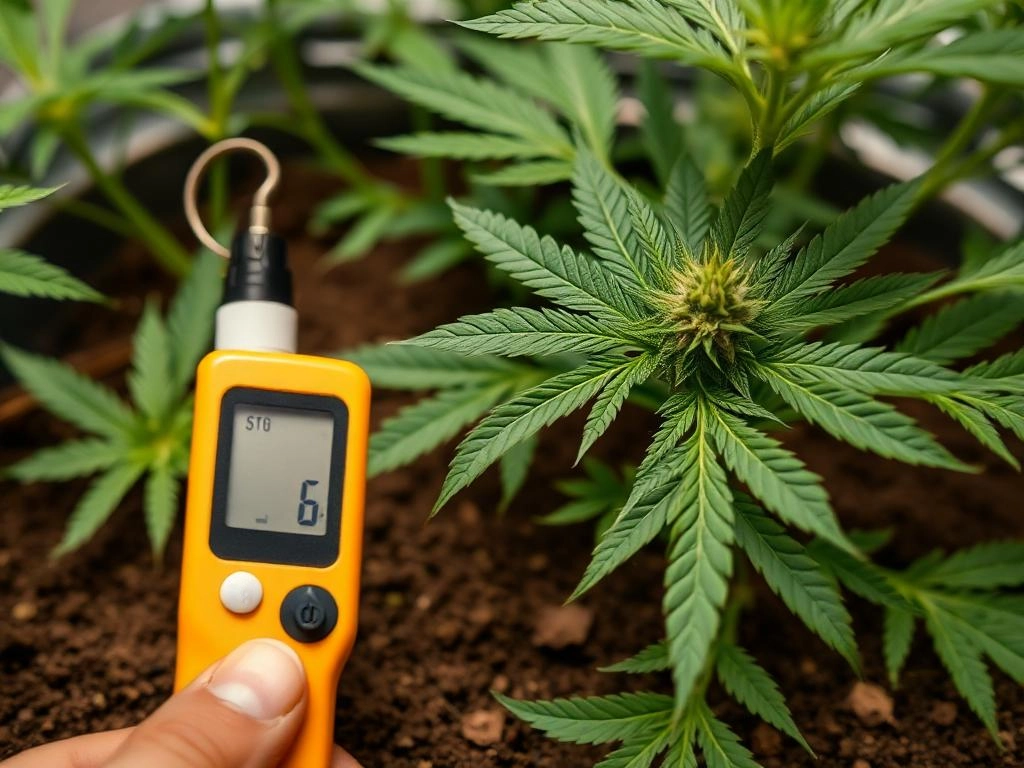
To prevent cannabis nutrient deficiency, we want to stress the importance of maintaining optimal pH and EC levels for each stage of the grow. Remember that during the vegetative stage, plants do not need an EC that is too high and may even prefer a slightly lower pH, while during flowering the demand for nutrients is greater and the pH range can be slightly higher.
Discover the Best Seeds for Optimal Growth at Sweet Seeds®!
If you want to maximize the performance of your grow and avoid nutrient deficiencies in cannabis from the very beginning, it is essential to start with high-quality seeds. At Sweet Seeds®, we offer a wide range of strains designed for vigorous and healthy growth.
Explore our selection of autoflowering, photoperiod-dependent, F1 Fast Version® seeds, and much more, and find the perfect seeds for your next growing experience.
Sweet Seeds S.L. is not responsible for any misuse of the information provided in this article. Growing Cannabis may constitute a criminal offense or administrative infraction; please check the Cannabis legislation applicable in your place of residence. Sweet Seeds S.L. does not, under any circumstances, intend to promote illegal practices.

Deputy Director of the Content and Image Department at Sweet Seeds®.
Articles by Jaypp (see all)
- How to Germinate Marijuana Seeds: Basic Guide - 8 de October de 2026
- How to Fertilize Your Cannabis Plants Easily - 16 de September de 2026
- CBD for Osteoarthritis: How Can It Help? - 16 de September de 2026