
Cart
There are no more items in your cart



Low Stress Training (LST) for Cannabis
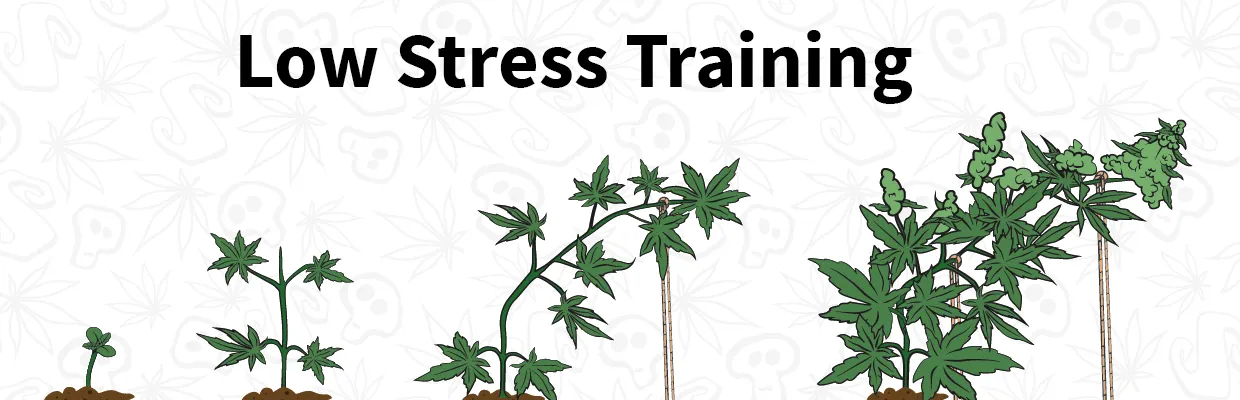
Low Stress Training in cannabis, also known as LST, is a growing technique that is becoming increasingly popular among home growers looking to improve the yield and quality of their cannabis plants. This method involves gently and carefully manipulating the plant’s structure without causing serious damage, with the aim of maximizing light exposure and encouraging more balanced growth.
Low Stress Training in cannabis allows plants to develop multiple branches and encourages them to grow outward rather than straight up. This technique is ideal for indoor growers who want to make the most of their space and achieve larger, more uniform harvests. In addition, applying LST correctly makes it possible to control plant height, which is essential for discreet grows or spaces with height restrictions.
What Is Low Stress Training?
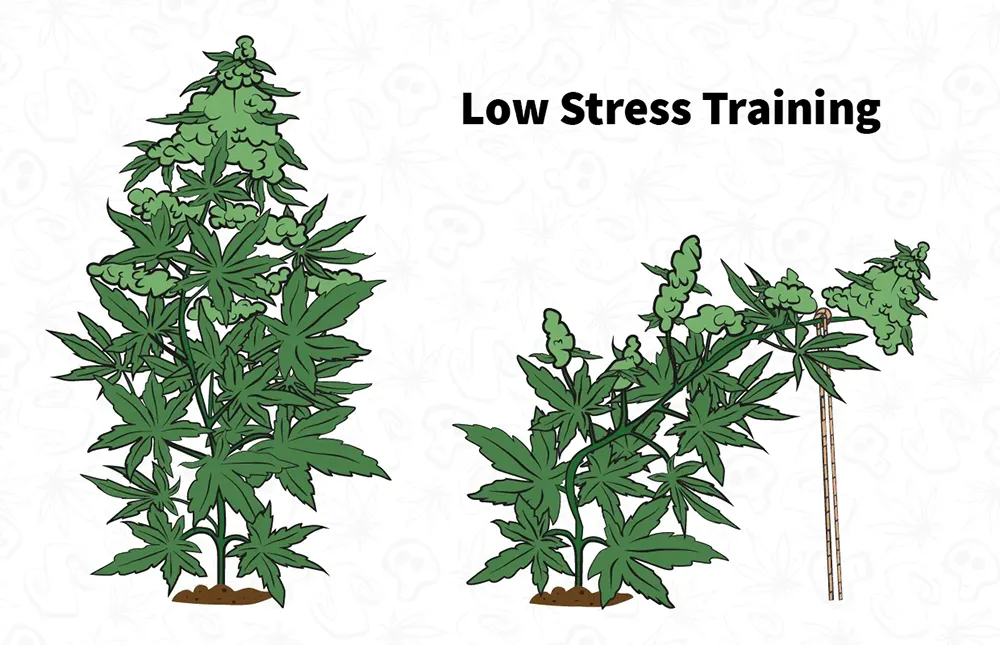
Low Stress Training is a growing technique that involves gently and gradually bending and tying down the branches of a cannabis plant without breaking the stems. Unlike more aggressive methods such as topping or heavy pruning, LST does not subject the plant to extreme stress, allowing it to continue growing in a healthy way.
The basic principle of Low Stress Training in cannabis is to redistribute the plant’s energy so that growth is no longer concentrated at the main growing tip but is shared among the lateral branches. When branches are bent downward or sideways, the plant redistributes the hormones responsible for growth (auxins), encouraging the development of side shoots and promoting more uniform growth.
By opening up the plant and exposing every area to light, you encourage the development of multiple flowering sites, resulting in more buds of better quality.
Low Stress Training in cannabis is ideal for both beginners and experienced growers because it is easy to learn and very effective. It requires patience and consistency, but the results are usually very satisfying in terms of both yield and plant health. Once you have learned the technique, you can use it in future grows.
Benefits of Low Stress Training in Cannabis
Low Stress Training offers a wide range of benefits for cannabis growing, especially in confined spaces or indoor grows where optimizing the available area is essential. It is also useful outdoors because it helps shape the plant, making it less visible to prying eyes.
Using it together with ScrOG is ideal for achieving large harvests and enjoying multiple benefits. Imagine, for example, that you do not want your plants to grow above a wall or the railing of a terrace. This technique can solve that problem.
Here are some of the main benefits:
- Increased yields: By creating multiple main branches, you can obtain more buds and a larger harvest.
- Better light distribution: All parts of the plant receive light more evenly, promoting growth and photosynthesis. This makes much better use of the intensity of indoor grow lights.
- More balanced, healthier plants: Mold problems are reduced as air circulation is improved.
- Height control: Ideal for small spaces or for keeping grows discreet.
- Suitable for any strain: Low Stress Training in cannabis can be applied to both indica and sativa strains, whether photoperiod-dependent or autoflowering.
Improved Light Distribution and Photosynthesis
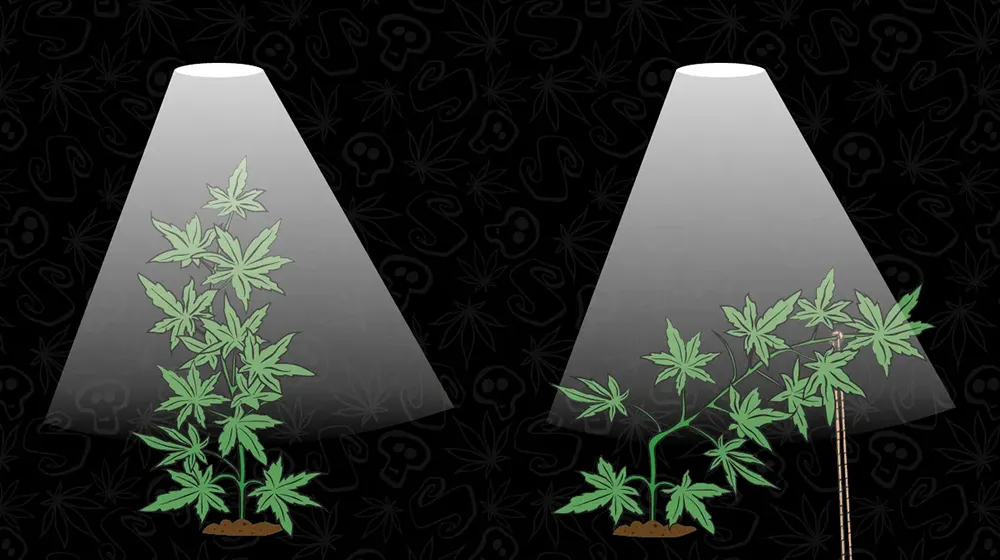
One of the major benefits of Low Stress Training is that it significantly improves light distribution. When a plant grows naturally, most of the light energy is concentrated at the main growing tip, leaving the lower branches in the shade. Thanks to Low Stress Training in cannabis, you can open up the plant and expose all its branches to light, increasing the efficiency of photosynthesis.
This more balanced distribution of light not only promotes more even growth but also improves bud quality and size, since all the buds receive a similar amount of energy. It is a pleasure to see large colas developing throughout the plant. Ideally, this technique should be combined with pruning the lower growth to concentrate more of the plant’s energy in the areas most exposed to light.
Optimizing Space in Small Grows
Low Stress Training is the perfect technique for growers working on balconies, in small grow tents, or in other confined spaces. By controlling plant height and spreading branches horizontally, you can make better use of the available growing area.
Low Stress Training in cannabis also makes it possible to keep plants at a discreet height, which is essential for urban grows or whenever privacy is a priority. In addition, by encouraging more lateral growth, you can cover the entire growing area with well-formed buds and avoid wasting space that would otherwise remain unproductive.
How to Perform Low Stress Training on Cannabis
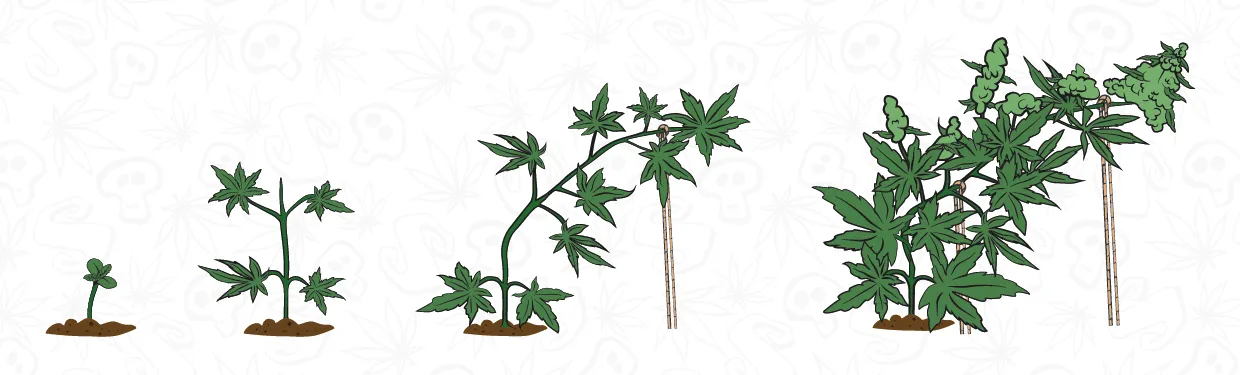
Applying Low Stress Training in cannabis is a gradual and delicate process, especially with weak plants or those showing uneven growth. Start when the plant has at least four or five well-developed nodes and is in the vegetative stage. Carefully bend the main branches sideways, a little at a time, and secure them using wire, string, clamps, or clips.
The aim is to create an open, horizontal structure in which all the branches have direct access to light. It is important to check the plant every few days to adjust the ties and continue guiding its growth. This process can continue for several weeks until you achieve the desired shape.
At this point, it may be useful to prune the lowest parts of the plant that remain in the shade, redirecting energy toward the areas that receive more light.
Low Stress Training in cannabis is especially useful in grows with LED lights, where even light distribution further encourages lateral development. Combined with certain pruning techniques and SCROG, it can result in highly productive plants.
Choosing the Right Branches for Training
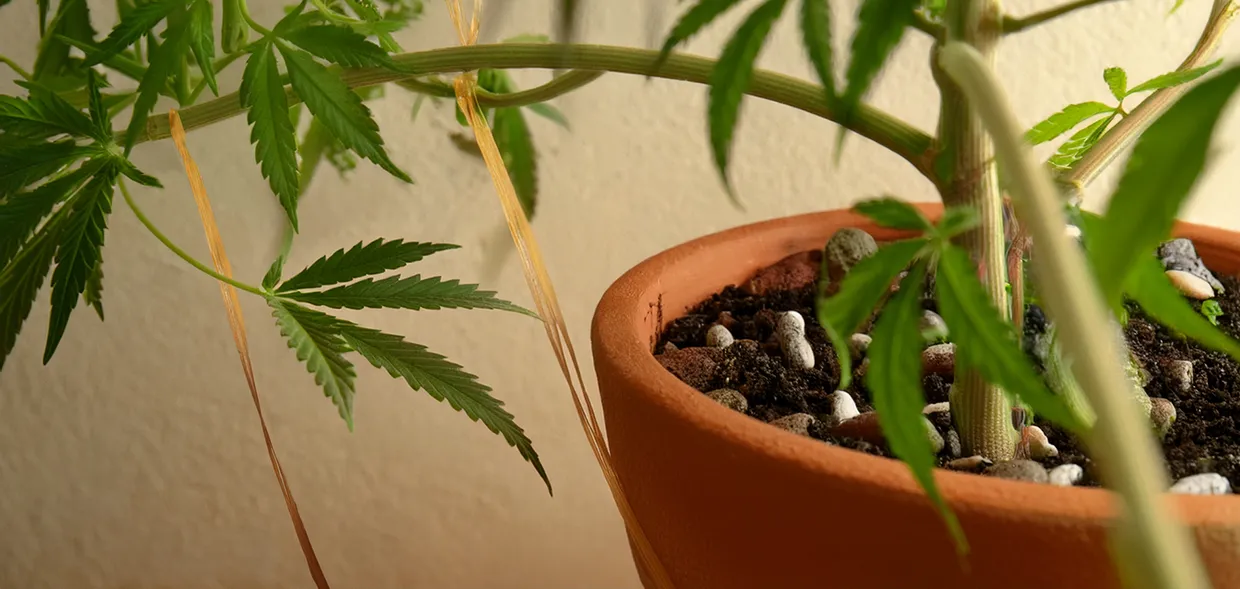
Choosing the branches to bend is essential for successful Low Stress Training in cannabis. Ideally, you should start with the main stem and then work on the most vigorous lateral branches. It is preferable to bend young, flexible branches, since they are less likely to break.
The upper branches can be guided sideways, while the lower branches can be allowed to grow upward, creating a more balanced structure. If a branch is accidentally damaged, it can be repaired with adhesive tape, since the plant has a remarkable ability to regenerate. Just be sure to act quickly.
Tools Needed for Low Stress Training
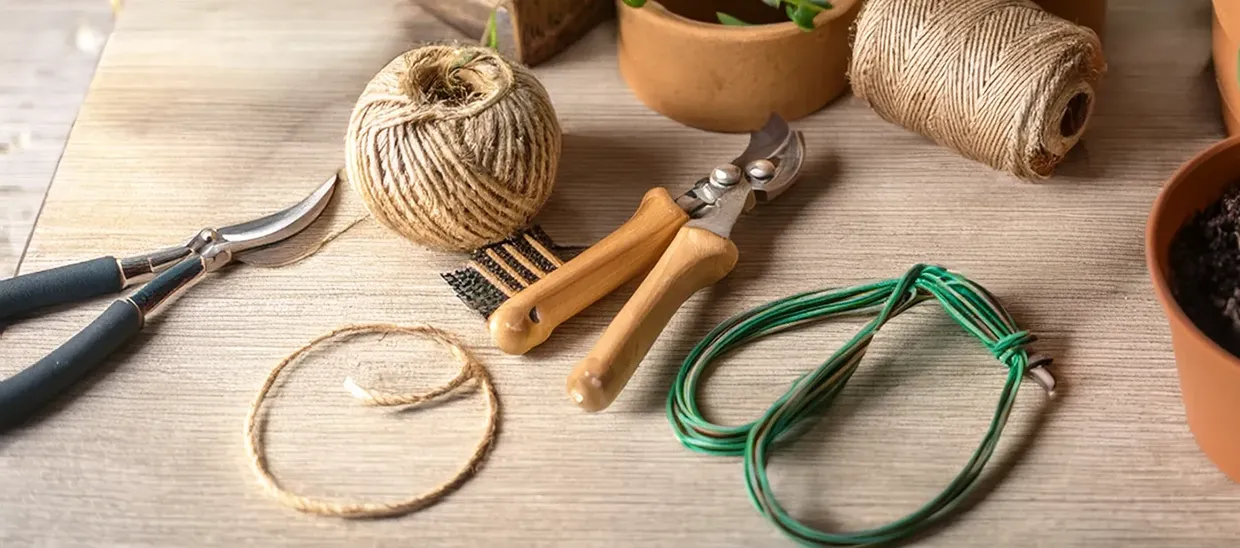
Low Stress Training in cannabis does not require complex tools, but it is important to have a few basic items to make the job easier:
- Soft string or plastic-coated wire to avoid damaging the stems.
- Clips or hooks to secure branches to the rims of the pots.
- Pruning scissors for making occasional adjustments.
- Clamps or small weights for bending more resistant branches.
- A little patience and dedication to check and adjust the training regularly.
Important Considerations When Using Low Stress Training in Cannabis
Although Low Stress Training in cannabis is a low-risk technique, it is essential to take certain precautions to make sure it is effective and does not harm the plant. A common mistake is applying too much pressure or trying to bend branches that have already become too rigid. If a branch is difficult to bend, do not force it; instead, bend it in several stages, a little more each day.
It is also essential to respect the plant’s recovery time. Avoid forcing it constantly without allowing it to adapt to the changes. With autoflowering strains, the time available is shorter, so training needs to be even gentler and more carefully planned.
When to Start LST
Low Stress Training in cannabis should begin during the vegetative stage, when the plant is still young and flexible. Ideally, start shaping it around the third or fourth week of growth, when its structure is strong enough to support the ties but still easy to bend.
With autoflowering plants, it is crucial to start as early as possible because their life cycle is shorter. If you begin Low Stress Training in cannabis too late, the branches will be more rigid and easier to damage.
Avoid doing this once flowering is well underway, as it can stress the plant and increase the risk of breaking a branch carrying sizable buds. You would not want to lose a developed bud because of poor technique. If you have no choice because the plant is growing beyond the ideal height (too close to the lights), proceed very carefully and over several sessions; do not try to bend it as far as possible on the first day.
Care and Recovery After LST
After each bend you make with Low Stress Training in cannabis, it is important to observe the plant and give it time to recover. A good sign that the plant is responding well is that the leaves and branches quickly reorient themselves toward the light. If they remain bent over and pointing toward the ground, this may indicate that sap is not flowing properly because the stem is broken or bent too sharply, restricting the flow.
It is also advisable to maintain balanced nutrition and monitor humidity. If a branch breaks, there is no need to panic: cannabis has a remarkable ability to heal, and if the branch is secured correctly, it can recover and continue growing. A piece of cellophane tape or electrical tape can work wonders.
Common Low Stress Training Mistakes and How to Avoid Them
Low Stress Training in cannabis is an accessible technique, but if you are a beginner, avoid these mistakes:
- Bending too quickly: Guide the branches gradually, without sudden movements.
- Bending overly thick branches: Applying force to branches that have already hardened can cause them to break. Always start during the vegetative stage and bend them gently.
- Failing to monitor the plant: Check the plant frequently to adjust its ties.
- Ignoring recovery time: Plants need a few days to adapt to each change.
- Using unsuitable materials: Unprotected wire can damage the stem. Use soft ties or string that will not harm the branches.
- Applying LST during flowering: Although it is not impossible, it is much riskier. Ideally, finish LST before flowering begins to avoid stress.
Low Stress Training or High Stress Training: Which Is Better?
Low Stress Training in cannabis and High Stress Training (HST) are two different approaches to improving plant structure and productivity.
While LST aims to guide growth gently, HST involves aggressive pruning and techniques such as super cropping, which subject the plant to considerable stress to trigger a defensive response. If you are not familiar with HST, we recommend starting with LST to learn how plants respond to training.
Why Choose Low Stress Training Over High Stress Training?
Low Stress Training in cannabis is ideal for growers who prefer methods that are less invasive and less risky for their plants. It is perfect for those who want to keep growth under control while minimizing risks.
LST offers greater control and is safer for beginners, while HST can deliver quick results but leaves more room for error. For most home growers, Low Stress Training in cannabis is the best option because of its simplicity, effectiveness, and lower impact on the plant. Will you join “Team LST”?
Get the Best Seeds for Your Grow at Sweet Seeds®
If you want to put Low Stress Training in cannabis into practice and grow vigorous, resilient, and productive plants, you need quality seeds. At Sweet Seeds®, you will find a wide selection of photoperiod-dependent and autoflowering strains that respond very well to Low Stress Training.
Sweet Seeds® seeds have been selected for their aromatic profiles, adaptable structure, and ability to develop dense, flavorful buds. Whether you are looking for fast-flowering strains or plants with high THC content, Sweet Seeds® has ideal options to help you maximize your results with Low Stress Training.
We hope you have learned about one of the most useful and fundamental techniques for growing your own cannabis. Sweet harvests!
Sweet Seeds S.L. is not responsible for any misuse of the information contained in this article. Cannabis cultivation may constitute a criminal offense or an administrative violation; please consult the cannabis legislation applicable in your place of residence. Sweet Seeds S.L. does not intend, under any circumstances, to encourage illegal practices.
Deputy Director of the Content and Image Department at Sweet Seeds®.
Articles by Jaypp (see all)
- How to Germinate Marijuana Seeds: Basic Guide - 8 de October de 2026
- How to Fertilize Your Cannabis Plants Easily - 16 de September de 2026
- CBD for Osteoarthritis: How Can It Help? - 16 de September de 2026